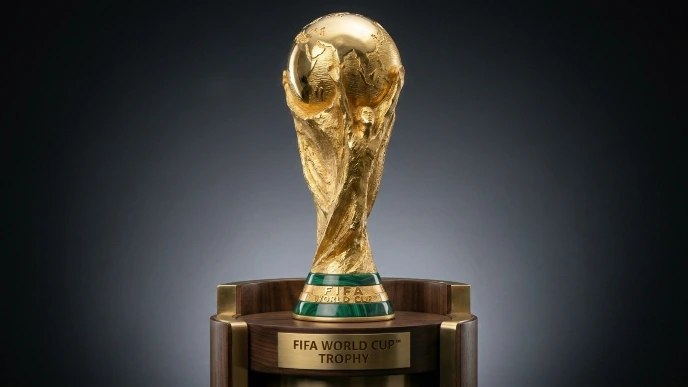
The question sounds simple which is how much is the world cup trophy worth?. It is not. The World Cup trophy has two completely different answers depending on how you look at it, and the gap between those two numbers is one of the most interesting financial stories in sport.
The raw material value of the trophy sits somewhere between $250,000 and $620,000, depending on the current gold price. The estimated market value based on prestige, rarity and historical significance is close to $20 million. That gap is not a mistake. It is the entire point.
What the Trophy Is Actually Made Of
The current FIFA World Cup Trophy has been in use since 1974. It stands 36.8 centimetres tall and weighs 6.175 kilograms in total. The body is made from 18 carat gold, which means it is 75% pure gold mixed with other metals for durability and to give it that deep yellow lustre.
The trophy is hollow inside rather than solid. If it were solid gold at the same dimensions, it would weigh somewhere between 70 and 80 kilograms, which would make lifting it above your head after a World Cup final considerably less elegant. The hollow construction brings it down to a weight that is substantial enough to feel significant but practical enough for a Lionel Messi or a Didier Deschamps to raise with one hand.
The base is made from two layers of green malachite, a semi-precious stone. The base is where the names of each winning nation are engraved after every tournament. Brazil, Germany, Italy, Argentina, France, Uruguay, England, and Spain all appear on it. There are spaces remaining for future winners.
| Specification | Detail |
| Height | 36.8 cm |
| Total weight | 6.175 kg |
| Gold type | 18 carat (75% pure) |
| Pure gold content | Approximately 5 kg |
| Base material | Green malachite |
| Designer | Silvio Gazzaniga (Italy) |
| In use since | 1974 |
| Owner | FIFA |
The Raw Material Value
The gold content of the trophy is approximately 5 kilograms of pure gold. At current gold prices as of May 2026, that gold is worth somewhere between $250,000 and $620,000 depending on which source you use and which price point you calculate from. The malachite base adds relatively little, perhaps a few thousand dollars at most.
So on pure materials alone, the most coveted prize in world football is worth less than a mid-range London flat.
That number feels absurd until you realise the trophy is not solid, is not made from the most expensive alloys available, and was designed in 1974 when gold prices were a fraction of what they are today. Silvio Gazzaniga, the Italian sculptor who created it, was not trying to make the most valuable object in the world. He was trying to make the most meaningful one.
The Real Value: Why Experts Put It at $20 Million
The estimated market value of the World Cup trophy comes in at close to $20 million according to analysts and reports cited by The Athletic. That figure is not based on gold content. It is based on three things that cannot be melted down.
Uniqueness. There is one authentic FIFA World Cup Trophy. It is stored at the FIFA World Football Museum in Zurich under one of the most sophisticated security systems in Switzerland and is removed only for specific official occasions. You cannot buy it, you cannot win it permanently, and you cannot replicate its provenance.
History. The trophy has been lifted by Pele, by Maradona, by Zidane, by Messi. It has been present at every World Cup final since 1974. The list of hands that have held it is a who’s who of the greatest footballers the game has ever produced. That history adds intangible worth that no gold price index can capture.
Impossibility of sale. FIFA would never permit the authentic trophy to be auctioned, which paradoxically increases its theoretical value. The rarer something is and the more forbidden it is to trade, the more collectors are willing to pay for the idea of owning it. The $20 million figure reflects what would happen in a theoretical auction. The reality is that auction will never take place.
What Winners Actually Get to Keep
Here is a detail that surprises most people. The winning nation does not get to keep the original trophy.
After every tournament, FIFA takes the authentic trophy back to Zurich. Each winning nation instead receives a gold plated bronze replica called the World Cup Winners Trophy, identical in appearance but made from bronze with a gold coating.
So when you see the trophy cabinet at the Argentine Football Association or the French Football Federation, what you are looking at is a very convincing replica. The real one has been in a vault in Switzerland since shortly after the final.
The Trophy That Was Stolen Twice and Melted Down
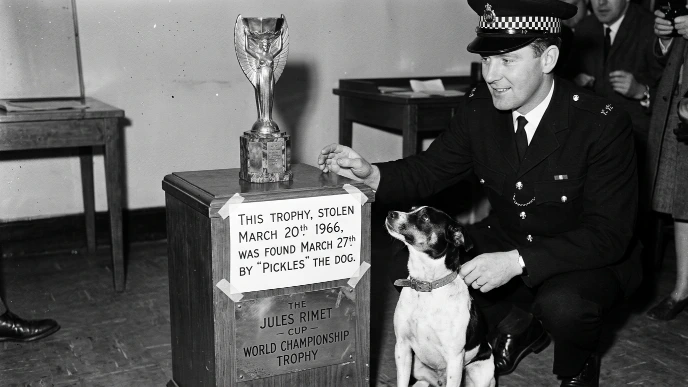
The current trophy replaced the original Jules Rimet Trophy, which had an even more dramatic history. Made from gold plated silver and lapis lazuli. It was used from 1930 to 1970.
In March 1966, four months before England hosted the World Cup, the trophy was stolen from a stamp exhibition at Westminster’s Central Hall in London. Scotland Yard launched an investigation. A ransom demand arrived at the Football Association for £15,000. The country went into a collective panic.
One week later, a dog named Pickles solved the case. The black and white collie was being walked near his South London home by owner David Corbett when he began sniffing at a parcel under a hedge. Corbett unwrapped it and found the World Cup trophy, wrapped in newspaper. Pickles became a national hero. Corbett received a reward of around £6,000. The dog got a film role.
England went on to win the tournament that summer, which only added to the mythology.
Brazil won their third World Cup in 1970 and were given the Jules Rimet Trophy in perpetuity under the FIFA rules of the time, which stated any nation winning three times would become permanent owners. In December 1983 the trophy was stolen from the Brazilian Football Confederation offices in Rio de Janeiro. Brazilian police concluded that the thieves melted it down into gold bars. Some investigators believe it may have been sold to a private collector and still exists somewhere. It has never been recovered.
FIFA commissioned the new trophy from Silvio Gazzaniga in 1971. The current version was first awarded in 1974 when West Germany beat the Netherlands.
The Prize Money Behind the Trophy
FIFA World Cup — winner prize money
USD millions, 1982–2026
The trophy itself may be worth $20 million in theory. The prize money that comes with winning the World Cup in 2026 is $50 million in cash, confirmed by FIFA in April 2026 as the largest winner’s payout in tournament history.
That $50 million goes to the national football association of the winning team, not the players directly. Individual player bonuses are negotiated separately between each federation and its squad. France reportedly paid their players a bonus of around $400,000 each for winning in 2018. Argentina’s structure in 2022 was similar in scale.
The $50 million prize in 2026 compares to $42 million that Argentina collected for winning in Qatar in 2022, and the $2.2 million Italy received when FIFA first began publicly disclosing prize money in 1982. The trophy has not changed much in 50 years. The financial reward that comes with lifting it has increased by more than 2,000%.
FAQ
How much is the World Cup trophy worth? The raw material value based on gold content is between $250,000 and $620,000 depending on current gold prices. The estimated market value based on prestige and rarity is close to $20 million.
Is the World Cup trophy solid gold? No. It is made from 18 carat gold but is hollow inside. A solid gold version of the same size would weigh between 70 and 80 kilograms, which would make it impossible to lift during celebrations.
Do World Cup winners keep the trophy? No. FIFA retains the authentic trophy in Zurich. Winning nations receive a gold plated bronze replica called the World Cup Winners Trophy.
What happened to the original World Cup trophy? The original Jules Rimet Trophy was stolen in England in 1966 and recovered by a dog named Pickles. It was later given permanently to Brazil after their third win in 1970, stolen again in 1983, and is believed to have been melted down. It has never been recovered.
How much prize money does the World Cup winner receive in 2026? The 2026 World Cup winner receives $50 million from FIFA, the highest prize payout in tournament history.
Launch Your Readymade Template Business
2,500+ Canva templates across 30 local business niches. Ready to sell. No design skills needed.
Restaurants, Roofers, Salons & 27 more niches
