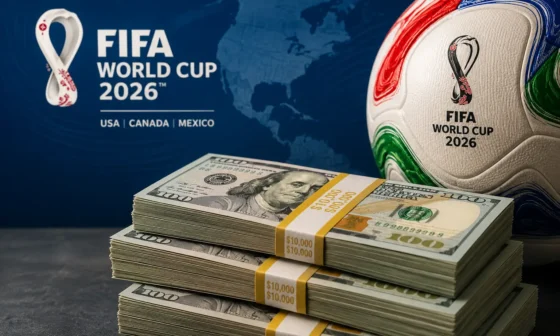
World Cup Players Get Payout
The winning federation at the 2026 World Cup collects $50 million from FIFA. The players who actually win it? They get whatever their federation decides to give them. That distinction matters more than most fans realise, and the gap between what FIFA pays out and what lands in a player’s bank account is one of the most misunderstood financial stories in sport.
Here is how it actually works, what the top nations pay, and why a player from one country can earn ten times more than another for the same result.
How the Money Actually Reaches Players
FIFA does not pay players. Full stop.
The prize money goes directly to each nation’s football federation. From there, the federation decides how much to pass on to the squad, how to structure the payments, and whether bonuses are tied to results or paid as a flat fee regardless of contribution.
Most federations negotiate a player agreement before the tournament covering three things: a base appearance fee per match, performance bonuses tied to each round reached, and a final winning bonus if the team lifts the trophy. The percentages vary dramatically by country.
Broadly speaking, high-income football nations like Germany, England, and France typically give 50 to 70 percent of the total prize money to their players, retaining the remainder for federation operations and development programmes. Lower-income nations, particularly from Africa and Asia, tend to allocate a higher percentage directly to players, sometimes 70 to 90 percent, because the sums are genuinely life-changing for individuals and the federation calculates that retention and motivation outweigh the development budget consideration.
What Players Earn Country by Country
Exact bonus figures are often confidential, but enough has been confirmed or leaked over tournament cycles to build a reliable picture.
| Nation | Reported winning bonus per player | Source / Year |
| France | ~$400,000 per player | 2018 confirmed |
| Argentina | ~$400,000 per player | 2022 estimated |
| England | ~$350,000 to $450,000 per player | 2018 to 2022 estimates |
| Germany | ~$350,000 per player | 2014 confirmed |
| Brazil | Negotiated individually for 2026 | beIN Sports, May 2026 |
| USA | Structured via CBA agreement | Ongoing |
Brazil’s arrangements for 2026 are worth noting specifically. Reports from beIN Sports confirmed that stars including Vinicius Junior, Casemiro, Marquinhos, Alisson, and Bruno Guimaraes have negotiated special incentives for winning the tournament, moving away from the flat-fee model used in previous cycles toward a structure that rewards their most commercially valuable players differently from the wider squad.
The USA operates under a Collective Bargaining Agreement that governs all player payments for the national team. The structure is transparent by design, with agreed payment tiers for each round reached. It is one of the few national team payment systems that is publicly documented rather than confidentially negotiated.
The Tax Problem Nobody Talks About
Players do not keep their full bonus. Not even close.
Most players face tax rates of between 35 and 50 percent on World Cup earnings depending on their country of residence and the tax treaty arrangements in place between their home nation and the tournament host countries. A player receiving $400,000 as their winning bonus could take home as little as $200,000 after tax in a high-rate jurisdiction.
Some federations negotiate structures to minimise this. Payments routed through certain jurisdictions, timing of payments relative to tax years, and federation-level arrangements with host country revenue authorities can all affect what players actually net. The details are rarely made public.
For players from lower-income nations, the tax burden can be disproportionately punishing. A Senegalese or Moroccan player earning $150,000 in World Cup bonuses faces a significant tax bill in countries where that sum represents a meaningful share of their annual income.
What Club Salaries Look Like Alongside Tournament Pay
The World Cup bonus is a single payment on top of a player’s regular club salary, not a replacement for it. For elite players, the bonus is significant but not transformative relative to what they earn year-round.
Kylian Mbappe earns an estimated $72 million per year at Real Madrid. A $400,000 World Cup winning bonus is less than three days of his club salary.
For a squad player from a smaller nation earning $80,000 per year at a domestic club, the same $400,000 bonus is five years of income arriving in a single payment. The World Cup pays the same trophy bonus to both players. It means something entirely different to each of them.
The salary gulf across squads at the 2026 World Cup is extreme. Hard Rock Bet published analysis showing Christian Pulisic leads the USA squad at $115,280 per week at AC Milan. The lowest-paid player in the same squad earns $6,731 per week. Among the 48 squads at the tournament, that spread is even wider.
| Player | Weekly club salary (approx) | Nation |
| Kylian Mbappe | ~$1.38M | France |
| Vinicius Junior | ~$865,000 | Brazil |
| Jude Bellingham | ~$600,000 | England |
| Pedri | ~$346,000 | Spain |
| Christian Pulisic | ~$115,280 | USA |
| Erling Haaland | ~$980,000 | Norway |
Figures represent estimated gross weekly wages at club level, May 2026.
What Clubs Get Paid for Releasing Players
Players are not the only ones receiving money from the World Cup. Their clubs get paid too.
FIFA distributes $355 million to clubs through the Club Benefits Programme for the 2026 tournament, compensating them for releasing players during the competition. This is a significant increase from the 2022 edition, reflecting the expanded 48-team field and longer tournament window.
The payments are calculated based on the number of days each player spends with their national team. A club releasing three players who all reach the final gets considerably more than a club releasing one player who exits in the groups. For elite clubs with large international squads, the Club Benefits Programme amounts to tens of millions of dollars across a single tournament.
Manchester City, Real Madrid, Barcelona, and Bayern Munich are historically among the highest-receiving clubs from this programme, simply because they supply the most players to the most competitive national teams.
What Winning Means Beyond the Bonus Cheque
The financial story of a World Cup winner does not end with the bonus payment. Winning the World Cup is the single greatest catalyst for individual commercial value in football.
A player who lifts the trophy in July 2026 returns to their club as a world champion. Sponsorship deals, image rights agreements, and boot contracts are all renegotiated upward. The market value on Transfermarkt increases. The next club contract comes with more leverage.
France players renegotiated commercial deals within months of winning in 2018, with reported uplift of 20 to 50 percent on existing sponsorship arrangements. Messi’s commercial brand value increased by an estimated $100 million across 2023 alone following Argentina’s win in Qatar.
The bonus is the smallest financial consequence of winning. The commercial cascade that follows is where the real money is.
FAQ
Do World Cup players get paid directly by FIFA? No. FIFA pays the prize money to each nation’s football federation. The federation then distributes a portion to the players based on a pre-agreed bonus structure. The amount each player receives varies significantly by country.
How much does a player earn for winning the World Cup? Approximately $350,000 to $450,000 per player for the major football nations, based on confirmed and estimated figures from 2018 to 2022. The exact amount depends on the federation’s bonus structure and how much of FIFA’s $50 million winner prize they pass on to the squad.
Do all players in a World Cup squad receive the same bonus? It depends on the federation. Most nations pay a flat bonus to all squad members regardless of playing time. Some, like Brazil for 2026, have reportedly moved to structures that reward key players differently.
How much tax do players pay on World Cup earnings? Most players face tax rates of 35 to 50 percent on tournament earnings depending on their country of residence and applicable tax treaties. A $400,000 bonus can be reduced to as little as $200,000 after tax.
Do clubs get paid when their players go to the World Cup? Yes. FIFA distributes $355 million to clubs through the Club Benefits Programme for the 2026 tournament, compensating them for releasing players. Payments are based on the number of days each player spends with their national team.
Player salary data from Hard Rock Bet analysis, March 2026. Bonus figures from confirmed federation disclosures and reporting by The Athletic, beIN Sports, and SportingIntelligence across the 2018 to 2026 cycle. Tax guidance is general and does not constitute financial advice.
Launch Your Readymade Template Business
2,500+ Canva templates across 30 local business niches. Ready to sell. No design skills needed.
Restaurants, Roofers, Salons & 27 more niches